

Deep Dive: Understanding Treatment Settings
Navigating the mental health system can feel overwhelming. Few people plan ahead for entering treatment, and services can look very different depending on the hospital, clinic, or program you access. To make matters more complex, many facilities offer multiple levels of care, which can be confusing if you don’t know what to expect. Knowing the differences between treatment settings can help you or your loved one choose the most appropriate level of care and increase the chances of recovery.
If you or your loved one has BPD, the treatment journey may involve moving between different levels of care. The most important thing is to find programs and professionals with specialized training in BPD, since not all mental health settings are equipped to provide effective treatment.
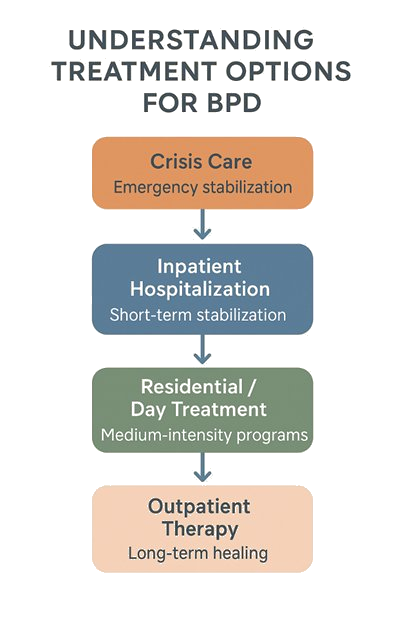
Emergency Psychiatric Services
- What it is: Crisis care provided in an emergency department or psychiatric emergency service.
- What to expect: The focus is immediate stabilization through short observation, medication, or procedures. Time is usually limited, and staff are working to manage the crisis quickly rather than provide ongoing therapy.
- For people with BPD: Emergency department visits can help in moments of crisis but are not designed for accurate diagnosis or long-term treatment.
- Best for: Emergencies when there is immediate risk of harm.
General Psychiatric Ward (Inpatient Hospitalization)
- What it is: A highly structured, locked facility designed for short-term crisis stabilization. Admission may be voluntary (“I don’t feel safe”) or involuntary (if someone poses a danger to themselves or others).
- What to expect: The focus is stabilization, not long-term treatment. Clients usually see a therapist once a week, and medications are often prescribed. The stay is typically short—sometimes called “catch and release.”
- For people with BPD: These units rarely provide specialized BPD treatment (like DBT or Schema-Focused Therapy). In fact, symptoms may sometimes worsen because of the environment and lack of tailored care.
- Best for: Acute crisis situations when immediate safety is the priority.
Residential Treatment
- What it is: A live-in program at an unlocked facility with staff available 24/7.
- What to expect: Programs vary widely. Some are highly specialized with therapies like Dialectical Behavior Therapy (DBT), while others provide more general mental health care. Treatment typically includes individual therapy, group sessions, and skill-building.
- Best for: People who need structured support and safety, but not hospital-level supervision. Often a good next step after inpatient stabilization, or when outpatient therapy isn’t enough.
Partial Hospitalization / Day Treatment / Intensive Outpatient (IOP)
- What it is: A middle ground between inpatient and outpatient. Programs typically run 4–5 days a week, 3–6 hours per day.
- What to expect: Structured schedules with individual therapy, group therapy, and skills training. When these programs specialize in BPD (for example, DBT or Schema Therapy–based), they can be highly effective.
- Best for: People who need more support than weekly therapy but don’t require 24/7 residential care. Often used as a step down from inpatient or residential, or as a step up when outpatient isn’t enough.
Outpatient Therapy
- What it is: Care while living at home. Outpatient can range from weekly individual therapy sessions to more structured programs with group therapy and skills training.
- What to expect: Outpatient treatment can be general (any therapist) or specialized (for example, a DBT program specifically designed for BPD).
- Best for: Most people with BPD once immediate crises are stabilized. Outpatient treatment allows for long-term, evidence-based therapy and the opportunity to practice skills in daily life.