
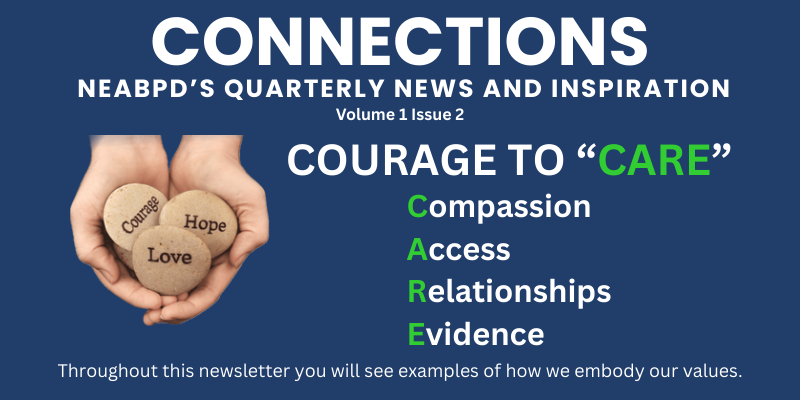
Connections Newsletter Volume 1 Issue 2
Compassion: A Sudden Turn

Victoria’s life took an unexpected and harrowing turn when her daughter attempted suicide for the first time at just 14 years old. The family rushed to the emergency room, where her daughter was stabilized and then sent home with strict instructions: lock away all sharp objects and medications, keep the bathroom door open, and provide constant supervision. With no clear guidance on how to help her daughter recover, Victoria improvised the best she could. She set up a cot next to her bed for her daughter, and kept her hand on her daughter through the night, trying to create a sense of safety and reassurance during those sleepless nights.
It took nine long weeks to secure a place in an intensive outpatient program (IOP). During that time Victoria juggled the roles of parent, safety monitor, and care coordinator, yet often felt overwhelmed and unprepared for the responsibilities that came with each role. “I didn’t know how to support my daughter or keep her safe,” she recalls. “There were no roadmaps for a parent suddenly thrust into this world.”
Following two rounds of IOP and a partial hospitalization, as well as numerous individual therapists, her daughter gradually regained a sense of stability. She managed to graduate high school and even felt ready to venture across the country to begin college. Victoria was filled with a mix of anxiety and hope, believing her daughter had turned a corner.
However, during her second semester, tragedy struck the campus. Three students died by suicide, two of them residing in her daughter’s dormitory. The devastating losses had a profound impact, intensifying her daughter’s feelings of hopelessness and prompting her to withdraw from school and return home. Victoria left her job to stay by her side, fearing for her safety and feeling helpless as her daughter resisted further treatment. Trust in the mental health system had eroded.
Amid this uncertainty, Victoria discovered the National Education Alliance for Borderline Personality Disorder (NEABPD) and its Family Connections program, specifically the Managing Suicidality & Trauma Recovery (MSTR) course. For the first time, she found a community of other parents and caregivers who understood her experiences. “The program gave me a framework to understand emotional vulnerabilities,” Victoria says. “It helped me recognize the intense pain my daughter was going through and gave me the tools to manage my own fear.”
The skills Victoria learned allowed her to shift her focus from solely preventing crises to rebuilding a supportive and resilient family environment. Understanding the protective role of strong family support, she worked on improving her relationship with her daughter and strengthening their connection. “I learned when my own fear was getting in the way of using skills to help my daughter,” she explains. “The skills gave me something concrete to do, and I was grateful for that when everything else felt so out of control.”
As time passed, her daughter began to seek treatment on her own, gradually rebuilding her life. Today, she is doing well, with her mother’s support serving as a constant through the ups and downs of recovery.
Victoria credits the MSTR program with providing the skills that not only helped to save her daughter’s life but also helped her reclaim her role as a mother instead of a crisis manager. “I am eternally grateful for the connection we’ve rebuilt,” she says. “It’s been a long and challenging journey, but knowing that I can be there for her and help her navigate life’s difficulties has made all the difference.”
Victoria now dedicates herself to helping other families facing similar challenges. She is committed to sharing what she has learned through NEABPD and the MSTR program, hoping to empower more parents to build strong, supportive relationships that can be a lifeline for their loved ones during crises.
Access: From Diagnosis to Empowerment: How a Conference Changed My Path

I was diagnosed with Borderline Personality Disorder (BPD) at age 20 while I was in college. To say life was chaotic at the time would be an understatement. I struggled to maintain relationships with my roommates and clashed constantly with my parents. I felt everything so deeply — rejection, fear, emptiness — and I didn’t know how to regulate it. I didn’t have the words for what I was experiencing. I just knew I was in pain.
During that period, I hit a low point and attempted suicide. It was one of the darkest moments of my life. But somehow, I made it through. And when I came out the other side, I knew I wanted to do something meaningful with my experience. I decided that the best path forward for me was to become a therapist — not just to help myself heal, but to walk alongside others in their healing too.
I’m now in my second year of graduate school, studying to become a social worker. It hasn’t been easy. Balancing classes, internships, and my own mental health has been a constant juggling act. Like many students, I live on a tight budget, and most of my extra income goes toward therapy and medication.
One day, a friend of mine — who didn’t even know I had been diagnosed with BPD — casually mentioned a conference about an hour and a half away. It was hosted by Yale and the National Education Alliance for Borderline Personality Disorder (NEABPD). The moment they said it was focused on BPD, I felt something light up inside me. I knew I had to be there.
But money was tight, and I wasn’t sure I could afford the ticket or travel. I almost didn’t reach out — that familiar voice in my head whispered, You don’t deserve this. But I sent an email anyway. The response I received was full of kindness. The organizers told me they didn’t want finances to be a barrier, and they offered me a scholarship to attend.
I walked into that conference as a student, ready to learn — but with no intention of sharing my personal story. Then I heard two lived experience speakers share their journeys with BPD. Something shifted. I felt connected, seen, and inspired. For the first time, I realized that maybe my story was worth telling too.
After their talk, I nervously approached one of the speakers and shared parts of my own experience. It was the first time I’d opened up to someone outside my close circle of family and friends. It was scary. But it was also empowering. That moment helped me reclaim my narrative and I recently presented at my university about my experience with BPD. Receiving the scholarship didn’t just give me access to a conference — it empowered me to take another step forward in owning my story and using it for good.
It was truly a gift — one that I will carry with me, and hopefully one day, pass on.
Author: Carrie, A Yale NEABPD Conference Scholarship Recipient
Relationships: Strong Partnerships Creates Change

Harry Bruell is a Board Member and member of the Advocacy Committee of NEABPD and like most of us, has a personal story of a loved one with BPD.
Harry brings to his role in advocacy a long history of understanding the importance of relationships and partnerships in making change. Throughout his professional career in nonprofit management Harry has developed relationships with government decision makers to inform them of the problems faced by their constituents and how his non- profit organization and others are working to solve these problems. These decision makers are key to securing the legislation and funding his and other organizations need for their missions.
When a distraught family member’s loved one with BPD was legally excluded in the California judicial system from having the same path for treatment instead of prison given those with other major mental health disorders, our CEO, Abby Ingber – along with Emotions Matter – contacted Harry and the Advocacy Committee went to work. Led by Harry, NEABPD partnered with the CBHA (California Behavioral Health Association) and Emotions Matter to right this wrong.
After a year of reaching out through existing relationships and connections, a partnership with Assembly Member Gregg Hart developed to write and pass AB1412, the first piece of legislation in the country to positively impact BPD. Hundreds of advocates from across the country added their voices by calling California Governor Gavin Newsome and he signed it into law in 2023!
If you have or know of a problem related to BPD that could be helped through advocacy, please let us know by emailing Advocacy@neabpd.org. Your individual story could be the start of change for many!
Evidence: New Published Research Highlighting Family Connections™

Perhaps you have a teen or adult child who has made a suicide attempt. You probably feel intense fear, horror, helplessness. You may have PTSD and are so distressed that you might try in vain to control the situation even more or perhaps withdraw from it.
You’ve heard about the MSTR* course. It says it equips you with tools to reduce fear- and trauma-based emotions, manage other painful emotions, and enhance relationship skills to improve connections with your child and others. You think, “But does it work?”
It does!
A recent study showed significantly lower levels of grief, depression, and burden and dramatic improvement in skill mastery for parents who completed a trial MSTR class six weeks earlier. The study involved 78 parents who had children aged 14-35 who had at least one suicide attempt. The pre-test showed that the parents scored high for PTS-related problems. Alan Fruzzetti and Lucy Payne conducted the study and led the four in-person, large group intensive classes. This study follows several others published on the significant impact of Family Connections in the past 25 years.
It is our goal that these studies which demonstrate the effectiveness of MSTR and Family Connections will improve access to insurance coverage and treatment options for parents and those living with borderline personality disorder and emotional dysregulation.
*This evidence-based, free course offers education and a supportive environment for parents to obtain information and acquire skills to manage their distress more effectively and improve family relationships. It is available in two formats: once a week for 8 weeks or as a 2-day weekend intensive.
Why I Give Monthly to NEABPD

When my adult daughter developed BPD symptoms I was blindsided. I was shocked by her behavior toward me, her family, her friends, and anyone who crossed her path. BPD felt like a train wreck rolling down the track splintering the lives of those living with it and their families along the way.
By good fortune, I found my way to the “Family Connections” course offered by the NEABPD, helping me see BPD with hope and understanding — and teaching me real communication skills. I learned to recognize the many facets of the difficult-to-understand disorder known as BPD.
In addition to shining a light on BPD, we need to seek the help of our legislative system to address inequities in mental health care and ensure BPD is recognized for what it is and the treatments that work.
I give monthly because action and advocacy come at a price. They rely on fighters and funding. My donations are a tangible way to ensure the most—and best —avenues can be used to get the word out and affect change in the current system.
Legislators should be serious not only in recognizing BPD for the often-debilitating disorder it is, but for ensuring funding to expand availability of trained mental health providers. BPD is not a hopeless diagnosis. Evidence-based treatments are out there. We need more trained providers and funding for that training.
Lobbying for laws that protect BPD sufferers, just as they do other mental conditions, is still a work in progress but should be full speed ahead—as we are already late.
I encourage everyone to give monthly if they can. Our support means NEABPD can continue delivering programs and advocating for those affected by borderline personality disorder and chronic emotion dysregulation.
Suzanne Fox
Image Credit: IStockPhoto.com/Gizmo