
Research
Driving Research That Inspires Hope

The BPD Alliance believes that compassion must be paired with progress. We partner with leading universities and researchers to advance knowledge about borderline personality disorder (BPD) and chronic emotion dysregulation.
We Advocate For:
New, effective treatments for BPD
Strengthening family and community interventions
Advancement in the understanding of BPD and chronic emotion dysregulation
Increased research funding for BPD
Recently Published Research on BPD


Help Advance Understanding and Treatment of BPD
Research plays a vital role in improving care and deepening understanding of borderline personality disorder (BPD).
Participate in Research
The studies listed below are seeking volunteers. Each listing includes eligibility criteria and instructions on how to take part. Your involvement is voluntary, confidential, and helps advance evidence-based treatment.
These studies are run by the research teams listed and are not administered by the BPD Alliance.
Availability may be limited and can change at any time.
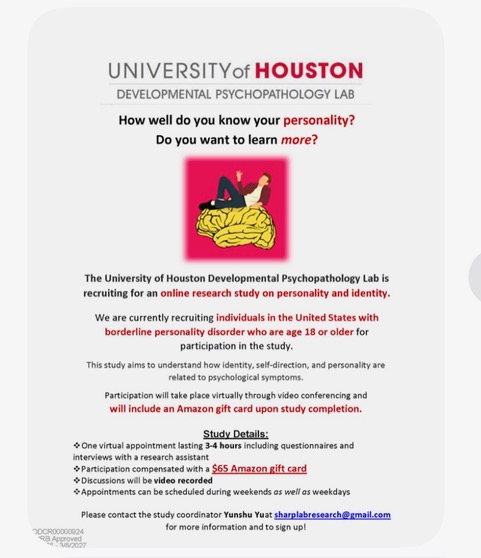
Researchers at the University of Houston are seeking adults with borderline personality disorder to participate in a study exploring how identity, self-direction, and personality are related to symptoms.
Eligible participants must complete a virtual appointment lasting 3-4 hours involving questionnaires and interviews with a research assisatant.
Criteria:
- Age 18+
- Reside in the United States
Compensation: $65 Amazon gift card
Email for additional information.
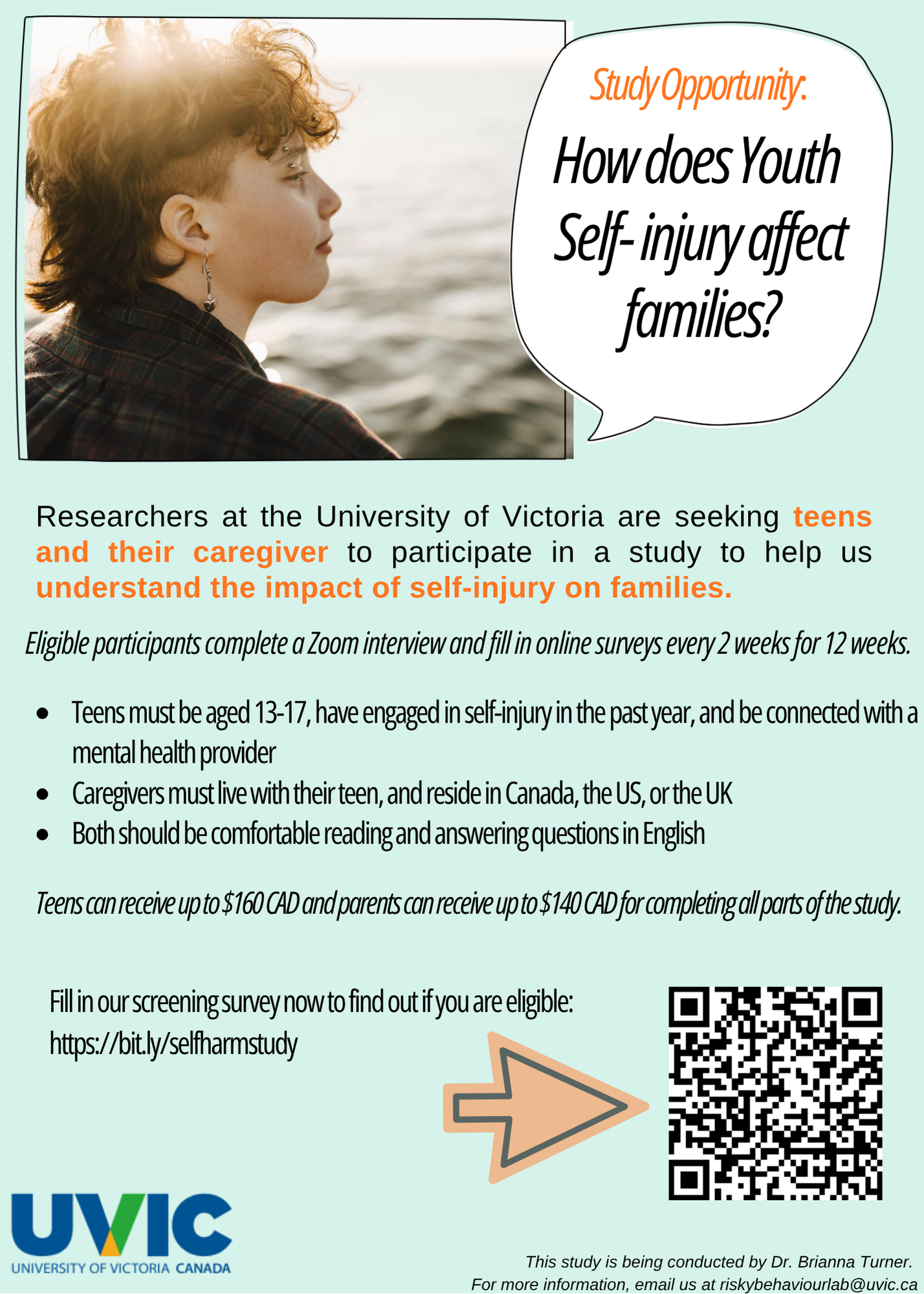
Researchers at the University of Victoria are seeking teens and their caregiver to participate in a study to help understand the impact of self-injury on families.
Eligible participants must complete a Zoom interview and fill in online surveys every 2 weeks for 12 weeks.
Criteria:
- Age 13-17
- Live with caregiver and reside in Canada, the US, or the UK
- Must have engaged in self-injury in the past year
- Must be connected with a mental health provider
- Both must be comfortable reading and answering questions in English
Compensation: Teens can received up to $160 CAD and caregivers can receive up to $140 CAD for completing all parts of the study
Emptiness in BPD
Directed by: Erik Nook, Ph.D., Principal Investigator
Location: Zoom/online questionnaire. Information provided after initial email communication.
Approval/Funding: The study is approved by the Princeton University IRB, Protocol #18700
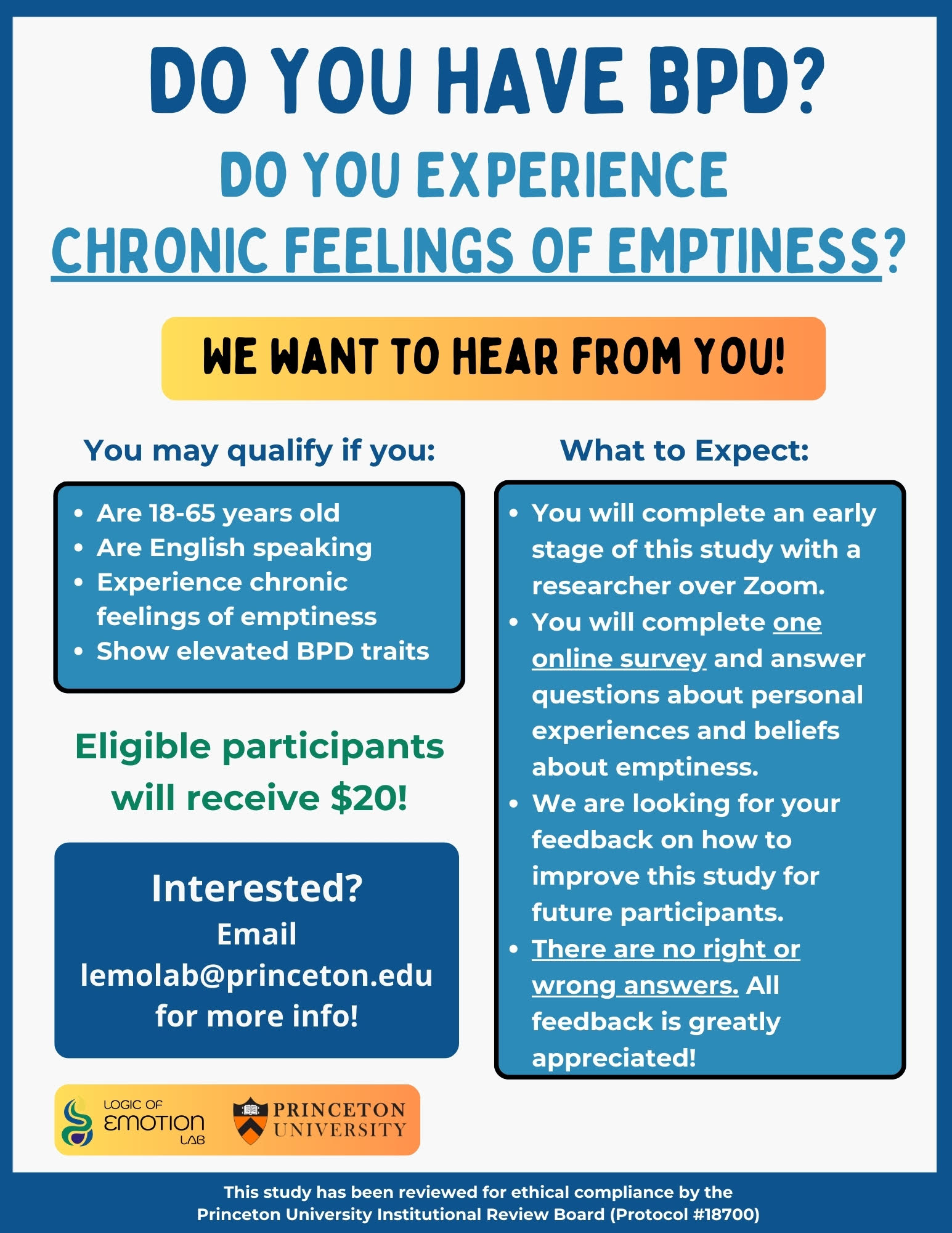
Description: We are interested in learning more about how people with BPD experience and think about emptiness, and how this relates to symptoms.
Commitment: As a pilot participant, you will complete an early stage of this study with a researcher over Zom. We are looking for your feedback on how to improve this study for future participants. There are no right or wrong answers; all feedback is greatly appreciated!
Criteria: Age 18-65, proficient in English, has experienced chronic feelings of emptiness, elevated BPD traits
Compensation: Eligible participants will receive $20
Contact: For more information, email lemolab@princeton.edu
For more information, please email.
Are you a teen with mental health struggles?
The Clinical Neuroscience Laboratory at Northeastern University is piloting the PEERS protocol, a group format Social Skills Intervention, created by folks out at UCLA, for teens with serious mental illness (SMI). The PEERS program has strong evidence of effectiveness with autistic youth, but has not been evaluated for teens with SMI.
This program is a virtual, 10-week, social skills class that enrolls teens, ages 13-17 years old, and at least one parent for 90-minutes each week and will be conducted over zoom.
Study details: We are defining serious mental illness rather broadly in this study. Teenagers with a diagnosis of a psychotic disorder, bipolar disorder, recurrent depression, or a hospitalization for a psychiatric disorder in the last year are eligible to participate. In this study, some people will be randomized to participate in a group right away (within a couple weeks) and some people will be asked to wait 10-12 weeks before starting the group.
Teens and parents will be compensated with gift cards for participation in the baseline assessment, the social skills groups, and the follow-up assessment.
We ask that all participating families provide the research team with contact information for a current clinician. Teenagers can participate in this study even if they are currently enrolled in other treatment (in fact, we ask that they ARE in other treatment of some kind at the time of enrollment!), unless they are currently enrolled in a residential program.
For more information, contact Sarah Hope Lincoln, Ph.D. with “PEERS” in the email subject line.
Have a sibling with personality disorder? We would love to hear from you.
The University of Houston Developmental Psychopathology Lab is looking for participants for an online research study about personal growth in siblings of individuals with personality disorder.
Study details: You are eligible to participate if you are:
- fluent in English;
- 18 years of age or older; and
- the sibling of someone with personality disorder.
You will complete one online questionnaire (takes roughly 30-40 minutes) and have the option to enter a raffle to win one of seventy-seven $20 Amazon gift cards (can be applied to countries outside the U.S.).
Questions? Email us.
We are sharing an online research study from a doctoral student at Spalding University. The study is about adults who were raised by a mother with Borderline Personality Disorder (BPD). The survey may help researchers understand this group better.
The survey asks about what life was like for you growing up and your current stress and well-being. It takes about 15–20 minutes. Your answers will be kept private, and you can stop at any time.
You can take part if:
• You are 18 or older
• Your mother has BPD
• You lived with your mother for most of your childhood
Interested in information about brain donations for mental illness research, please visit the Harvard Brain Tissue Resource Center’s information page at:
https://hbtrc.mclean.harvard.edu/brain-donation/info/
or their online registry:
Do you have Borderline Personality Disorder (BPD)?
If you are between the ages of 18 to 60 and live in CT or MA, you may be eligible for a BPD treatment study involving neurofeedback and psychotherapy.
Compensation will be provided.
If you’re interested, please fill out our survey to start the screening process. You can access the survey by clicking the link below:
https://redcap.med.yale.edu/surveys/?s=WA3PRR33DFKNKCJE
Sponsored by the National Institute of Mental Health and the Yale University School of Medicine;
HIC #2000037582
Are you an informal caregiver to a person diagnosed with Borderline Personality Disorder (BPD)?
Are you a friend, family member, or partner caring for someone with BPD?
Do you feel a sense of mental and physical exhaustion due to your caring role?
________
What are the criteria?
- Must be 18 years or over.
- A family member, friend or partner with a close relationship to a person diagnosed with BPD.
- Not professionally paid to care for a person diagnosed with BPD.
- Caring for person diagnosed with BPD for at least 6 months.
- Experiencing mental and physical exhaustion due to your caring role for at least 3 months.
What to expect?
A one-to-one MS team’s interview, up to 60 minutes.
Why?
Share your experiences to help us better understand the challenges caregivers face and find ways to enhance support services for them.
Participants will receive a £ 20 shopping voucher for their time
To take part or ask any questions, please email: Charlotte Moore (Lead Researcher) moorec31@coventry.ac.uk
Your voice matters! Help us understand and improve the caregiving experience for those affected by BPD.